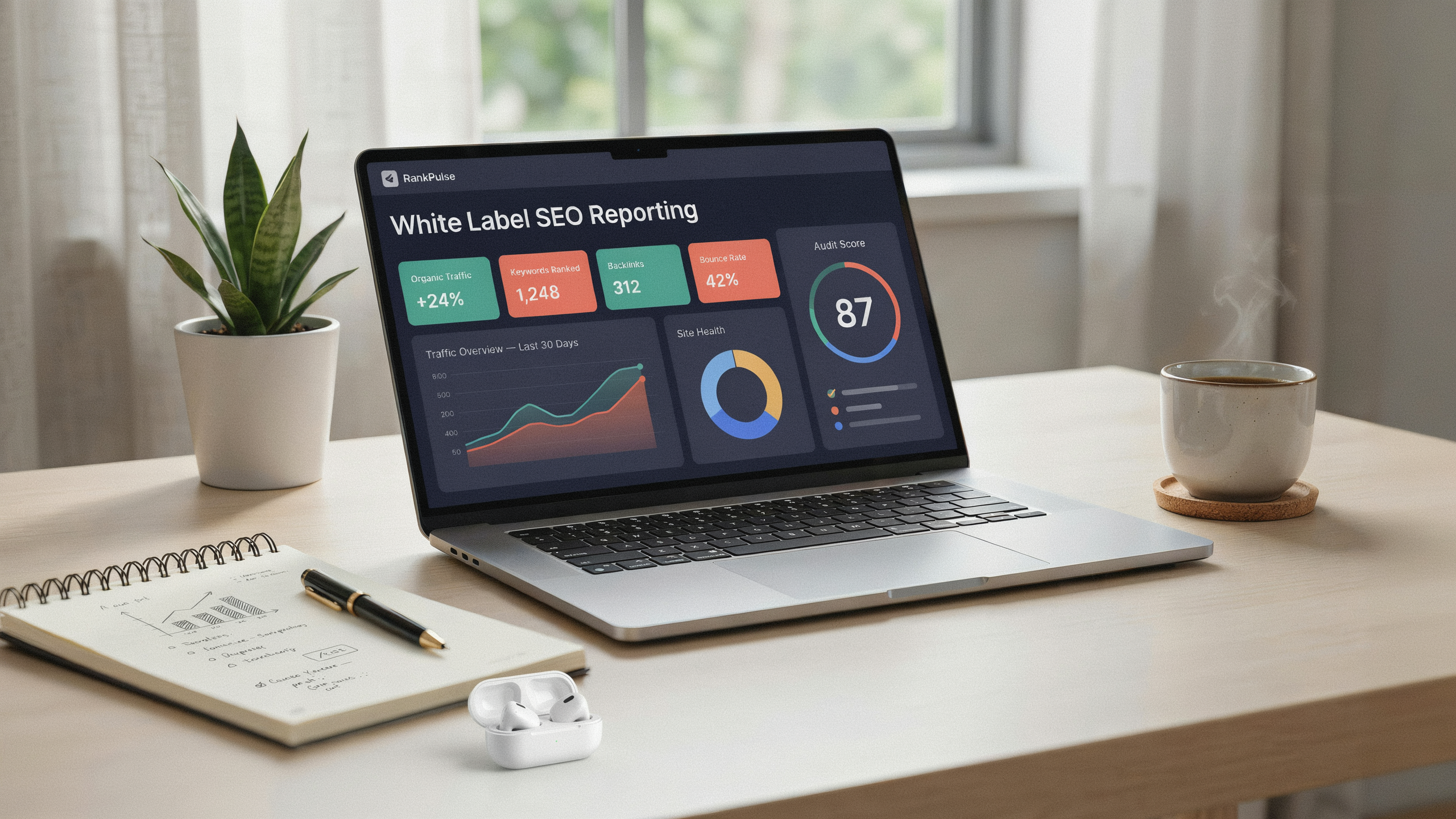
White label SEO reporting lets agencies deliver polished, client-ready SEO audits and performance dashboards under their own brand, without building the tooling in-house. For website owners, SEO professionals, and digital marketers, this means every report carries your logo, your colors, and your voice, while a serfix platform handles the data collection and formatting behind the scenes. The result is a faster path to client trust, because the work looks like it came from your team, not a third-party vendor.
Most agencies discover that manual reporting eats 10 to 15 hours per client each month. White label SEO reporting removes that bottleneck by automating data pulls from Google Search Console, Google Analytics, and rank trackers, then assembling the numbers into a clean, branded PDF or live dashboard. You keep the strategic relationship, the client sees consistent, professional reporting, and your team gets those hours back for actual optimization work.
Key Takeaways
- White label SEO reporting lets you deliver polished, branded client reports without building your own reporting infrastructure.
- Automated serfix workflows cut report assembly time from hours to minutes, so your team can focus on strategy instead of spreadsheets.
- Branded SEO reports reinforce your agency's identity, build client trust, and reduce the risk of clients shopping around for cheaper providers.
- Effective client SEO reporting means translating raw metrics into plain-language insights, recommendations, and next steps, not just dumping charts.
- The right white label audit tool should support custom domains, scheduled delivery, and white-label branding without requiring developer resources.
- Pricing white label SEO reporting as a value-added service, rather than a free add-on, protects margins and signals expertise to clients.
What Is White Label SEO Reporting?

White label SEO reporting is the practice of producing client-facing search performance reports under your own agency's brand, even when the underlying data collection and report generation are handled by a third-party platform. The client sees your logo, your color scheme, and your domain on every page, while the technical work happens behind the scenes. This lets agencies deliver polished, professional deliverables without building an in-house reporting infrastructure from scratch.
The core difference from in-house reporting is ownership of the tooling. In-house reporting means your team builds and maintains the data pipelines, dashboards, and report templates yourself. White label reporting flips that model: you license a platform that already does the heavy lifting, then rebrand its output as your own. For most agencies, the white label approach is faster to launch, cheaper to maintain, and easier to scale across dozens of clients, because you're not reinventing the report every time a new account comes on board.
A branded report typically contains four components. First, a summary page that highlights wins, losses, and next actions in plain language. Second, keyword ranking tables showing position changes for tracked terms, often segmented by page or campaign. Third, traffic and conversion metrics pulled from Google Analytics or Search Console, presented as trend lines rather than raw numbers. Fourth, a technical health section covering crawl errors, page speed, and indexation issues. The exact mix depends on the client's goals, but the branding layer stays consistent throughout.
What makes the model work is that the client never sees the underlying tool. They see a report that looks like it was hand-built by your team, even if it was generated automatically moments before delivery. That's the entire point of white label SEO reporting: the output belongs to your agency, not to the software that produced it.
Why Agencies Need Branded SEO Reports

Client retention in SEO is rarely about rankings alone. It's about whether the client believes the work is producing results, and that belief is built or broken every time a report lands in their inbox. A generic spreadsheet or a dashboard with someone else's logo sends a quiet message: this agency is just a middleman. Branded SEO reports flip that signal. When your agency name, colors, and logo sit at the top of every deliverable, the client's mental model shifts from "hired a vendor" to "partnered with an expert team."
Perceived value follows the same logic. Two agencies can deliver identical technical fixes and content updates, but the one that presents findings in a polished, branded document will be seen as more thorough, more professional, and more worth the retainer. That perception isn't vanity. It directly influences renewal conversations, upsell opportunities, and word-of-mouth referrals. Agencies that invest in white label SEO reporting are investing in the packaging that makes their expertise visible.
Trust compounds when reporting is consistent. Clients who receive the same branded format every month learn where to look, what to expect, and how to interpret the data. That predictability reduces the anxiety that drives churn. When a client trusts the report, they trust the agency behind it, and they're far less likely to shop around after a slow quarter. A well-branded report also gives account managers a natural script for client calls: the document becomes the agenda, the evidence, and the proof of work all at once.
Churn reduction is the financial payoff. Acquiring a new SEO client costs far more than retaining an existing one, and branded reporting is one of the cheapest retention tools available. It requires no new software, no additional billable hours, and no change to your service delivery. It simply changes how the work is presented. For agencies that already use a serfix workflow, adding branded reporting is a low-effort, high-impact upgrade that pays for itself in renewals.
Core Elements of a Client SEO Report
A client SEO report earns its keep when it answers one question before the client asks it: what changed, and why does it matter for revenue? The most effective reports group data into five sections, each tied to a business outcome rather than a vanity metric. Rankings show visibility, traffic shows audience, conversions show money, backlinks show authority, and technical health shows whether the foundation will hold. Agencies that structure reports this way spend less time explaining and more time advising.
Start with keyword rankings, but pair every movement with context. A drop from position 4 to 6 for a high-intent term matters more than a jump from 40 to 30 for a low-volume phrase. Group keywords by page or by funnel stage, and mark which movements correlate with on-site changes from the reporting period. Clients rarely care about the raw number; they care about whether the trend supports their growth plan.
Traffic deserves its own block, split by channel and landing page. Organic sessions, click-through rate, and average position from Search Console give a clean view of search performance. Compare against the previous period and the same period last year, because seasonality distorts month-over-month reads. If a landing page gained traffic but lost conversions, the report should flag it, not bury it.
Conversions are the section clients read first, so put it early. Track goal completions, conversion rate, and assisted conversions where attribution allows. Tie each conversion back to the page or keyword cluster that produced it. A white label SEO reporting workflow that automates this mapping turns a data dump into a narrative.
Backlinks need a dedicated section, even for clients who never ask about them. Show new links acquired, lost links, and referring domains, with a note on domain authority trends. One high-quality link from a relevant site often outweighs ten directory listings, and the report should make that trade-off visible.
Technical health closes the report with crawl errors, page speed, mobile usability, and index coverage. Frame issues by impact: a 404 on a top landing page is urgent, while a missing meta description on a low-traffic post is a cleanup item. Ranking the findings by priority keeps the client focused on fixes that move the needle.
Choosing a White Label Audit Tool
Selecting the right white label audit tool determines how smoothly your serfix reporting workflows run and how credible your agency looks to clients. The first thing to evaluate is customization depth. A strong tool lets you replace every default logo, color, and footer link with your own brand, so the final PDF or dashboard feels like an in-house product. Beyond branding, check whether you can reorder report sections, add custom commentary, and hide metrics that are irrelevant to a particular client. Rigid templates force you to explain away generic layouts, which erodes trust before the client even reads the numbers.
Data accuracy is the second non-negotiable. An audit tool that pulls stale rankings, miscounts backlinks, or mislabels technical issues will damage your reputation faster than no report at all. Look for a platform that refreshes crawls on demand, distinguishes between mobile and desktop results, and clearly timestamps every data point. When you present a finding like a broken redirect chain or a missing canonical tag, you need to be confident the tool is reading the live site, not a cached snapshot from three weeks ago.
Integration with existing workflows matters more than most agencies expect. The best white label audit tool connects to the tools you already use for project management, client communication, and internal reporting. If your team tracks tasks in a project board, the audit tool should export findings in a format that imports cleanly. If your clients expect weekly email summaries, the tool should support scheduled delivery without manual exports. A tool that lives in a silo adds friction to every reporting cycle, while one that fits your stack lets you produce branded SEO reports without rebuilding your process.
Finally, test the tool with a real client site before committing. Run a full audit on a domain you know well, then compare the output against your own manual checks. Pay attention to how the tool handles JavaScript-heavy pages, pagination, and sites behind login walls. A white label audit tool that produces accurate, customizable, well-integrated reports will save you hours every month and make your agency look more professional than competitors still stitching together screenshots in a spreadsheet.
SEO Report Automation: Saving Hours Every Month
Manual report building is the hidden tax on agency margins. An account manager might spend four to six hours per client each month pulling rankings, traffic, and conversion data into a branded template. With serfix automation, that work collapses to a few minutes of review. The system connects to Google Analytics, Search Console, and rank tracking sources, then assembles the numbers into your client-ready layout on a fixed schedule.
Automation removes the two biggest failure points in client reporting: human error and inconsistency. When a spreadsheet is updated by hand, a mistyped cell or a forgotten data pull can undermine trust. An automated pipeline pulls the same metrics the same way every time, so the report a client sees in March matches the methodology they saw in January. That consistency is what lets an agency scale from ten clients to fifty without hiring a dedicated reporting specialist.
Setting up recurring reports is straightforward. Most tools let you define the date range, the metrics to include, and the delivery channel, whether that's a PDF attached to an email or a live dashboard link. You can also schedule automatic distribution to clients on the first business day of the month, which removes the need for anyone to remember to hit send. The key is to configure the report once, then let the automation handle the rest. Agencies that adopt this approach typically reclaim ten to fifteen hours per month, time that can be redirected toward strategy and client communication.
How to Present Client SEO Reporting Effectively
Effective client SEO reporting isn't just about sending a PDF. It's about guiding the client through the numbers so they understand what changed, why it matters, and what happens next. Schedule reports on a fixed cadence, monthly for most retainers, and deliver them two business days before the call. That gives the client time to review and come with questions instead of reacting live.
Structure the call around three questions: What did we do? What did it produce? What are we doing next? Start with the headline metric, usually organic sessions or goal completions, then walk through the supporting data. When you explain a metric, tie it to a business outcome. Instead of saying "domain authority rose by three points," say "domain authority rose by three points, which historically correlates with a 12 percent lift in new keyword rankings for sites in your niche."
Use the report as a visual anchor. Share your screen and highlight the sections that matter most. Don't read the report aloud. The client can read. Your job is to interpret it, answer the question they're actually asking, and flag anything that looks like a problem before they find it themselves. If a metric dropped, address it in the first five minutes with the likely cause and your remediation plan. Clients forgive bad months when they see a clear response.
Leave ten minutes for questions, and write down anything you can't answer on the spot. Follow up within 24 hours. That habit alone separates agencies that retain clients from those that churn. A serfix audit report becomes a client retention tool when the presentation turns raw data into a story about growth.
Pricing White Label SEO Reporting Services
Pricing for white label SEO reporting typically follows one of three models: per-report fees, monthly subscriptions, or bundled packages that fold reporting into a broader service retainer. Per-report pricing suits agencies with sporadic client needs, often ranging from $50 to $200 per branded report depending on depth and customization. Subscription models, usually $150 to $500 per month, include a set number of reports plus ongoing access to the reporting platform. Bundled pricing, where reporting is part of a larger SEO or digital marketing package, is the most common for established agencies because it smooths revenue and simplifies client invoicing.
Several factors influence cost. The number of client accounts, frequency of report generation, level of white-label customization, and whether the tool includes automated data pulls from multiple sources all move the price. Agencies should also account for internal review time, even with automation, because a human check before delivery protects the brand. When evaluating a white label audit tool, compare not just the sticker price but the time saved per report; a tool that costs $300 monthly but saves ten hours of manual work is cheaper than a $50 tool that requires constant tweaking.
Positioning the value matters more than the line item. Instead of presenting reporting as an add-on cost, frame it as the client's window into performance. A well-branded report justifies the retainer, reduces churn, and creates upsell opportunities for additional services. Agencies using serfix often bundle reporting into retainers and find clients accept higher fees when the deliverable looks polished and professional. For a deeper look at how automation changes the economics, review the section on SEO report automation earlier in this article.
Common Mistakes in White Label SEO Reporting
Even experienced agencies undermine their own white label SEO reporting by repeating a handful of preventable errors. The most damaging is data overload: a 40-page PDF with every crawl metric, keyword movement, and backlink delta looks impressive but buries the insight clients actually pay for. A better approach is to lead with three to five outcomes tied to business goals, then let the technical detail sit in an appendix. If a client has to ask what a number means, the report has already failed its job.
Lack of context is a close second. A ranking drop from position 4 to 7 reads as failure unless the report notes that the page was outranked by two new competitors and a Google algorithm update affected the entire niche. Without that framing, clients panic and agencies lose trust. Every metric in a branded SEO report should answer the question: what changed, why did it change, and what are we doing about it?
Inconsistent branding is a quieter but equally corrosive mistake. When a report arrives with the agency's logo on page one and a third-party tool's watermark on page six, the client subconsciously questions who really did the work. White label SEO reporting only delivers its full value when every page, chart, and footer carries the agency's identity. This is where a serfix style workflow helps: the report is generated once, then automatically rebranded for each client without manual editing.
Finally, agencies miss the easiest win by ignoring SEO report automation. Teams that manually assemble reports every month spend hours on formatting instead of analysis, and they're more likely to ship errors. Automating data collection and report generation frees that time for strategic conversations, which is where retention is actually won.
Scaling Your Agency with White Label Reporting
Standardized white label SEO reporting does more than save time on individual deliverables; it creates a repeatable system that lets an agency onboard new clients without rebuilding processes from scratch. When every account uses the same report structure, the same metric definitions, and the same visual language, a new client can receive a polished branded audit within days rather than weeks. That consistency is what turns a service into a product, and products scale.
Onboarding becomes a checklist instead of a discovery project. A new client's Google Search Console, Google Analytics, and Google Business Profile are connected to the reporting platform, the agency's logo and colors are applied, and the first report is generated from the same template used for every other account. Team members don't need to learn a new workflow for each client, so junior staff can handle report production while senior strategists focus on interpretation and recommendations. The result is higher margin per account and the ability to take on more clients without adding headcount.
Growth also depends on the tools that feed the reports. An agency that relies on manual data pulls will hit a ceiling quickly, but one that uses serfix to automate rank tracking, site audits, and keyword monitoring can scale reporting output without scaling labor. The internal data pipeline becomes the agency's competitive advantage, because every client gets the same depth of insight regardless of account size.
Finally, standardized reporting supports client retention at scale. When clients know what to expect each month, they spend less time asking questions and more time acting on recommendations. That predictability reduces churn, and lower churn means the agency can invest in acquisition with confidence. White label SEO reporting isn't just a deliverable; it's the operating system for an agency that intends to grow.
Frequently Asked Questions
How much does white label SEO reporting cost?
Most agencies pay $50 to $300 per month for a white label audit tool, depending on client volume and feature depth. Some platforms charge per report, which gets expensive at scale. A flat monthly plan usually makes more sense once you pass ten active clients.
How long does it take to set up white label SEO reporting?
With a modern tool, you can generate your first branded SEO report in under an hour. That includes uploading your logo, choosing brand colors, connecting a client site, and running the initial crawl. Ongoing reports then take minutes, not days.
Can I automate white label SEO reporting for all my clients?
Yes. SEO report automation lets you schedule weekly or monthly reports that pull fresh data, apply your branding, and send themselves to each client. The key is setting up a template once, then letting the tool handle the rest.
What should I look for in a white label audit tool?
Look for full brand removal, custom domains, scheduled reporting, and white label PDF exports. The tool should also include competitor comparisons and clear action items, because clients want to see what you found and what you'll do next.
Does serfix white label support client-facing dashboards?
Yes. The serfix white label option includes a client portal where each account sees only their own data, under your agency branding. That keeps clients engaged between reports and reduces the number of "what changed this week" emails you receive.