
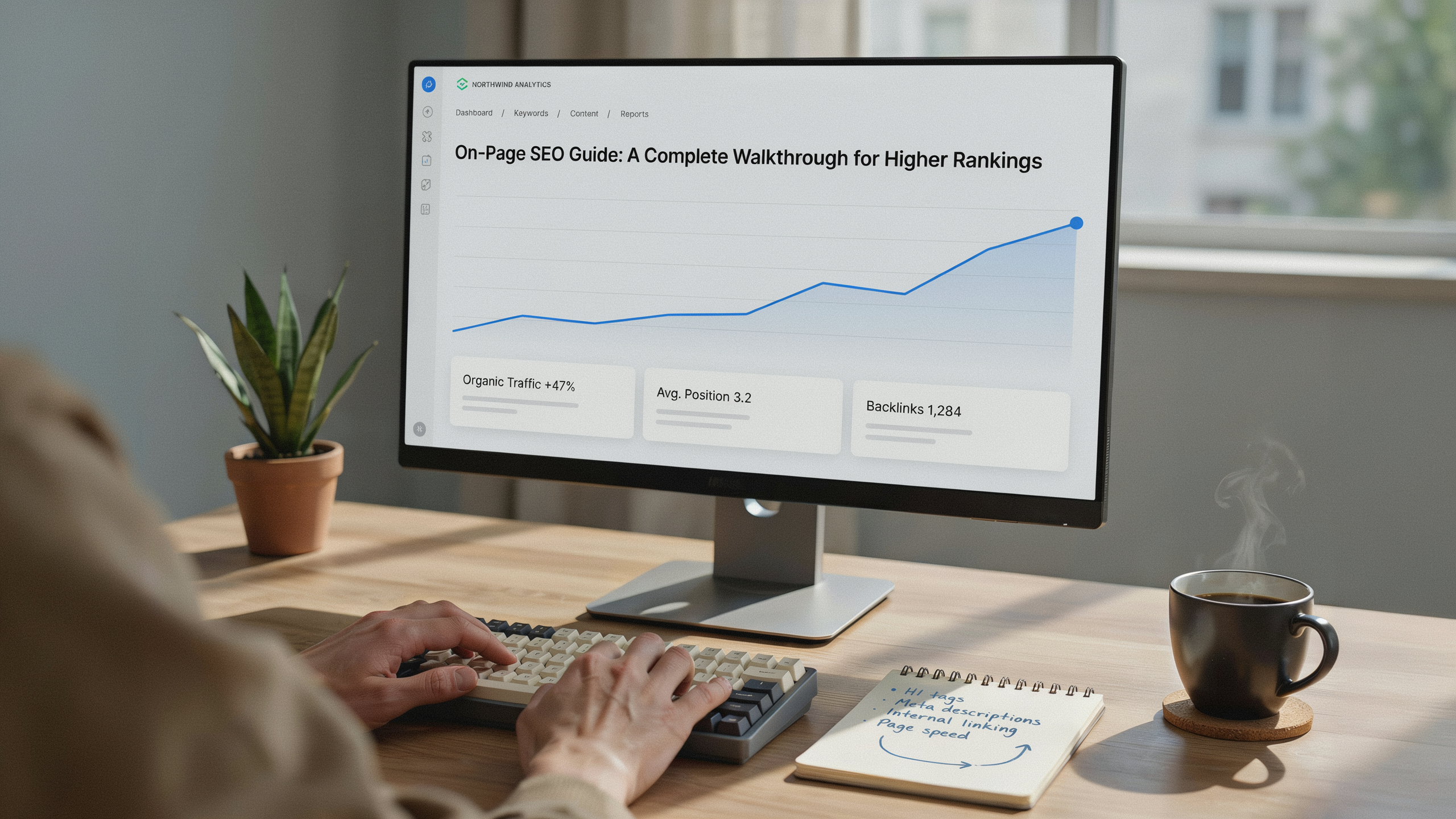
On-Page SEO Guide: Master Every Element for Higher Rankings
Welcome to this on-page seo guide, your complete resource for optimizing individual web pages to rank higher and earn more relevant traffic from search engines. On-page SEO is the practice of refining both the content and the HTML source code of a page. It makes it easier for search engines to understand your topic and for users to find exactly what they need. Whether you are a website owner, an SEO professional, or a digital marketer, this guide walks you through every critical element. From keyword placement and meta tags to internal linking and content structure. By the end, you will have a clear, actionable framework to improve your organic search performance and streamline your optimization workflow.
Key Takeaways
- An effective on-page SEO strategy starts with mastering elements like title tags, meta descriptions, and header structure to improve both rankings and click-through rates.
- Keyword placement in the first 100 words, title tag, H1, and body copy remains a core ranking signal, but density must stay natural to avoid penalties.
- Internal linking distributes authority across your site and helps search engines understand content relationships, making it a critical on-page tactic.
- Technical on-page factors such as page speed, mobile responsiveness, and schema markup directly impact user experience and search visibility.
- Regular audits of on-page SEO elements ensure your content stays aligned with evolving search engine algorithms and user intent.
What Is On-Page SEO and Why It Matters

On-page SEO refers to optimizing individual web pages to rank higher in search engines and earn more relevant traffic. Unlike off-page SEO, which focuses on external signals like backlinks, or technical SEO, which deals with site architecture and crawlability, on-page optimization centers on the content and HTML source code you control directly. This includes elements such as title tags, headings, body copy, and internal links. A well-executed on-page seo guide helps search engines understand your page's topic and assess its value to users. That directly influences your visibility in search results.
Beyond rankings, on-page SEO shapes the user experience. Clear headings, logical structure, and relevant content keep visitors engaged and reduce bounce rates. When you align your page with search intent, you attract clicks and satisfy the user's query, signaling quality to search engines. Strategic keyword placement within the first 100 words and in subheadings reinforces topical relevance without compromising readability. This balance between optimization and human-centric writing is what makes on-page SEO both an art and a science.
Search engines like Google use sophisticated algorithms to evaluate on-page factors. While they don't disclose exact weights, industry studies consistently show that well-optimized pages outperform those with thin or poorly structured content. A comprehensive on-page seo guide will always emphasize that these efforts are foundational. Without solid on-page optimization, other SEO tactics like link building or social media promotion yield diminishing returns. On-page SEO is the bedrock of your digital presence. It ensures that every piece of content you publish has the best possible chance to be discovered and appreciated by your target audience. For a deeper look at how Google's algorithms interpret page content, refer to Google's technology overview.
Keyword Research and Placement

Effective on-page SEO starts with understanding what your audience is searching for. Begin by brainstorming seed topics related to your business, then use tools like Google Keyword Planner or AnswerThePublic to expand your list. Look for terms with a balance of decent search volume and manageable competition. Long-tail keywords, which are longer and more specific phrases, often convert better because they capture intent. For example, instead of targeting "shoes," a more precise phrase like "women's waterproof hiking shoes" brings in visitors ready to buy. Once you have your list, prioritize keywords that align with your content goals and audience needs.
Strategic keyword placement is critical for signaling relevance to search engines. Your primary keyword should appear in the page's title tag, ideally near the beginning. Include it in the main heading (H1) and at least one subheading (H2). In the body text, use the keyword naturally within the first 100 words and then spread variations throughout the content. Avoid keyword stuffing; a density of 1-2% is usually sufficient. Also place the keyword in the URL slug, keeping it short and readable. For instance, a page targeting "on-page SEO guide" might use the slug /on-page-seo-guide. Meta descriptions, while not a direct ranking factor, should include the keyword to improve click-through rates from search results.
Beyond the primary term, incorporate secondary and LSI keywords to provide context. These related phrases help search engines understand the page's depth. If your main keyword is "on-page seo guide," related terms like "meta tags seo" or "internal linking seo" reinforce the topic. Use them in subheadings, image alt text, and within the body where they fit naturally. This layered approach to keyword placement ensures your content is comprehensive without feeling forced. The goal is to serve the reader first. Search engines reward pages that genuinely answer user queries with clear, well-structured information.
Crafting SEO-Friendly Title Tags
A title tag is the clickable headline that appears in search engine results and browser tabs. It remains one of the most influential on-page ranking factors. A well-written tag can dramatically improve click-through rates. In this on-page seo guide, we emphasize that every title tag should include the primary keyword near the beginning while reading naturally for users. Google typically displays the first 50 to 60 characters of a title tag, so keep the most important words within that limit. A strong title tag formula combines the target keyword, a compelling benefit or differentiator, and your brand name when space allows. For example, instead of a generic title like "Home Page," a more effective version would be "On-Page SEO Guide: Proven Techniques to Rank Higher | YourBrand." Avoid keyword stuffing, which can trigger spam filters and turn searchers away. Use action-oriented language and power words such as "complete," "essential," or "step-by-step" when they genuinely reflect the content. Each page on your site needs a unique title tag that accurately describes its content. Duplicate titles confuse search engines and dilute relevance. Tools like serfix.io can audit your title tags for length, keyword usage, and uniqueness across your site. Title tags also influence social sharing, as platforms like Facebook and Twitter often pull the title as the default headline. Testing variations with A/B tools can reveal which phrasing drives more organic traffic. By treating title tags as both a ranking signal and a marketing message, you align technical SEO with user intent, a core principle of effective on-page optimization.
Meta Descriptions That Drive Clicks
While meta descriptions do not directly influence rankings, they are a critical component of meta tags SEO because they shape the snippet users see in search results. A well-crafted meta description acts as organic ad copy, boosting click-through rates (CTR) and signaling relevance to search engines. To write compelling meta descriptions, keep them between 150 and 160 characters, include the primary keyword naturally, and focus on a clear benefit or solution. Use active language and a call to action, such as "Learn how to improve your on-page SEO" or "Discover proven strategies." Avoid duplicate meta descriptions across pages. Unique snippets help search engines understand each page's distinct value. Although Google may rewrite meta descriptions based on the query, providing a strong default increases the likelihood that your chosen text appears. By treating meta descriptions as a conversion tool rather than an afterthought, you can improve organic CTR and indirectly support your broader on-page SEO efforts.
Header Tags and Content Structure
Header tags (H1 through H6) create a logical hierarchy that helps both readers and search engines understand your page. The H1 serves as the main title and should include your primary keyword, such as "on-page seo guide," exactly once. Use only one H1 per page. H2 tags break the content into major sections, each covering a distinct subtopic. For deeper nesting, H3 tags subdivide H2 sections, and H4 tags can further organize complex topics. This structure improves readability by letting users scan the page quickly. It also signals topic relevance to search engines by grouping related ideas under clear headings. Avoid skipping levels, such as jumping from H2 to H4, because that disrupts the semantic flow. Instead, maintain a consistent hierarchy that mirrors an outline. When you include keywords naturally in H2 and H3 tags, you reinforce the page's topical focus without keyword stuffing. A well-structured page also increases the chance of earning featured snippets, as search engines can extract answers from clearly labeled sections. For any on-page SEO strategy, header tags are a foundational element that supports both user experience and crawl efficiency.
Writing High-Quality, SEO-Optimized Content
Creating content that ranks well and satisfies readers requires a careful blend of seo content writing principles and genuine value. The foundation is understanding user intent: every page should answer a specific question or solve a problem that your audience is actively searching for. Before typing a single word, review the top-ranking pages for your target query to identify what formats, depth, and angles are already succeeding, then find a way to offer something better or more up-to-date.
Readability is a direct ranking factor because search engines measure engagement signals like time on page and bounce rate. Break text into scannable chunks with descriptive subheadings. Keep paragraphs to three sentences or fewer. Use bullet points for lists. Aim for a reading level that matches your audience; for most consumer content, an eighth-grade level works best. Tools like the Flesch-Kincaid score can help you gauge complexity. The real test is whether a busy professional can grasp your key points in under 30 seconds.
Multimedia elements such as images, videos, and infographics increase dwell time and make complex topics easier to digest. Every visual should serve a purpose: a chart that illustrates a trend, a screenshot that walks through a process, or a short video that demonstrates a technique. Always compress files for fast loading and include descriptive alt text that naturally incorporates relevant keywords without stuffing.
Freshness matters because many queries, especially in fast-moving niches, favor recently updated content. Set a schedule to revisit cornerstone articles every six to twelve months. Update statistics, replace outdated examples, and add new sections that reflect current trends. Even small changes like refreshing the publish date or adding a new expert quote can signal to search engines that your content remains relevant. When you combine these practices with a solid on-page optimization approach, you create a resource that both users and algorithms will trust over time.
Internal Linking Strategies
Effective internal linking seo is a cornerstone of a solid on-page seo guide. It weaves your content into a coherent web that both users and search engines can navigate with ease. Each link you place from one page to another passes equity, sometimes called link juice, which helps distribute authority across your domain. When you link from a high-authority pillar page to a deeper, related article, you signal to Google that the target page is valuable and worth crawling more frequently. This practice also improves crawl efficiency by giving bots a clear path through your site. It reduces orphan pages that might otherwise go unnoticed.
A practical approach starts with topic clusters: identify a core pillar page and link out to cluster content that covers subtopics in detail. Then, from each cluster page, link back to the pillar and to other relevant clusters. Avoid generic anchor text like "click here"; instead, use descriptive phrases that include target keywords naturally. For instance, a page about keyword research might link to a guide on title tags with the anchor "crafting SEO-friendly title tags." This aids navigation and reinforces topical relevance for search engines.
Tools like serfix.io can streamline the audit process by identifying broken links, orphan pages, and opportunities to add new internal links where they will have the most impact. Regularly review your site structure to ensure that every important page is no more than three clicks from the homepage. Prune or update links as your content evolves. By treating internal linking as an ongoing strategy rather than a one-time task, you build a resilient architecture that supports both user experience and long-term SEO performance.
URL Structure and Optimization
A clean, descriptive URL is a small but powerful element of any on-page seo guide. It tells both users and search engines what a page is about before they even click. The best URLs are short, readable, and contain the primary keyword near the front. For example, a page targeting "on-page seo guide" would benefit from a URL like /on-page-seo-guide/ rather than /p=123 or /category/seo/on-page-seo-guide/ which adds unnecessary depth. Avoid stop words like "and" or "the" and use hyphens to separate words. Google treats hyphens as word separators while underscores are not recognized. A logical folder structure that mirrors your site's hierarchy also helps, but keep it shallow: most pages should be no more than three clicks from the homepage. When updating an old URL, always implement a 301 redirect to preserve any existing link equity. Consistency matters: once you choose a URL pattern, stick with it across your site to avoid confusion and crawl inefficiencies.
Image Optimization for On-Page SEO
Images are often the heaviest elements on a page, so optimizing them directly impacts load speed, user experience, and rankings. A well-structured on-page SEO workflow treats image optimization as a core task, not an afterthought. Start with descriptive file names that include target keywords where natural: on-page-seo-guide-checklist.jpg is far more useful to search engines than IMG_001.jpg. Alt text serves a dual purpose, providing context for screen readers and helping search engines understand image content. Write concise, accurate descriptions that incorporate relevant terms without stuffing. For a chart showing keyword placement best practices, "Keyword placement heatmap for on-page optimization" works better than a generic label.
Compression is the next critical step. Tools like TinyPNG or ShortPixel can reduce file size by 50-80% with minimal quality loss, which directly improves Core Web Vitals. For responsive delivery, use the srcset and sizes attributes to serve appropriately scaled images based on viewport width, or adopt modern formats like WebP and AVIF that offer superior compression. Lazy loading (via the loading="lazy" attribute) defers off-screen images, further speeding up initial page load. These technical adjustments, combined with proper caching headers, ensure that your on-page seo guide remains fast and accessible across all devices.
Technical On-Page Elements
Technical on-page optimization ensures search engines can crawl, understand, and index your pages without friction. Three core elements stand out: schema markup, canonical tags, and mobile-friendliness. Each plays a distinct role in how your content appears in search results and how users experience it.
Schema markup adds structured data to your HTML, giving search engines explicit clues about your content's meaning. For example, an article with Article schema can display rich snippets like headline, author, and publish date directly in SERPs. A product page with Product schema might show price, availability, and review stars. These enhancements improve click-through rates because they make your listing more informative at a glance. Implementing JSON-LD is straightforward: you inject a script block into the page head without altering the visible layout. Google's Structured Data Testing Tool validates your markup, catching errors before they affect performance.
Canonical tags prevent duplicate content issues by signaling the preferred version of a URL. When multiple URLs serve identical or near-identical content (common with session IDs, tracking parameters, or printer-friendly pages), a canonical tag consolidates ranking signals to the master URL. This is critical for e-commerce sites where product variants can generate dozens of URLs for the same item. A self-referencing canonical tag on every page is a safe default, but cross-domain canonicals are also supported when syndicating content.
Mobile-friendliness is now a direct ranking factor. Google's mobile-first indexing means the mobile version of your site determines your rankings. Responsive design, readable font sizes without zooming, and touch-friendly navigation are baseline requirements. Core Web Vitals (Largest Contentful Paint, First Input Delay, and Cumulative Layout Shift) quantify the user experience and influence rankings. Tools like PageSpeed Insights and Lighthouse provide actionable recommendations to improve these metrics. Together, these technical elements form the backbone of effective on-page optimization. They ensure your content is accessible, authoritative, and ready to compete.
Measuring On-Page SEO Success
Tracking the impact of your on-page seo guide implementation requires monitoring a handful of core metrics. Organic traffic, measured in Google Search Console or a rank tracker, tells you whether your optimizations are pulling in more visitors from search. Keyword rankings show how individual pages climb or fall for target terms. Click-through rate (CTR) from the search results page reveals whether your title tags and meta descriptions are compelling enough to earn the click. Bounce rate and average session duration, available in any analytics platform, signal whether visitors find your content engaging after they land.
An SEO audit tool like serfix.io can crawl your site and flag on-page issues such as missing meta tags, thin content, or broken internal links before they hurt rankings. Pair that with heatmap tools to see how users interact with your pages, and you can spot where content or layout needs adjustment. The real power comes from iteration: review the data every two weeks, identify pages where rankings have slipped or CTR is below 2%, and apply targeted fixes. Even small tweaks, like rewriting a meta description or adding internal links to a high-authority page, can lift a page several positions within a month.
Frequently Asked Questions
What is the difference between on-page SEO and off-page SEO?
On-page SEO covers elements you control directly on your website, such as content, title tags, and internal linking. Off-page SEO involves external signals like backlinks and social shares. Both are essential, but on-page optimization lays the foundation for search engines to understand and rank your pages.
How long does it take to see results from on-page SEO?
Improvements can appear within days for small changes, but significant ranking shifts often take weeks to months. Search engines need time to crawl and re-evaluate updated pages. Consistent optimization and monitoring speed up the process.
Is keyword density still important for on-page SEO?
Keyword density is no longer a strict ranking factor. Instead, focus on natural keyword placement in titles, headings, and body text. Overusing a phrase can hurt readability and trigger spam filters. Aim for a reader-friendly flow that includes your target terms where they fit organically.
How do I optimize images for on-page SEO?
Use descriptive file names, compress images for fast loading, and add alt text that includes relevant keywords. Properly sized images improve user experience and can rank in image search, driving additional traffic.
Can I do on-page SEO myself, or do I need a professional?
Many on-page SEO tasks are manageable with a solid on-page seo guide and basic tools. However, complex technical issues or competitive niches may benefit from professional expertise. Start with the fundamentals and assess your progress before seeking help.